
The Unicorn Problem
This is the neighborhood where I grew up. Gallup, New Mexico, on the edge of the Navajo Nation. That black dot is my starting line.
I am a member of the Navajo Nation. The direct descendant of a member of the Choctaw Nation. I grew up in a household that looked like that map—middle class, southwestern, Indigenous. My ancestors have lived on this land since before the concept of a zip code existed.
Here is what the data predicted for a girl like me, from a place like that: Pregnant by 18.
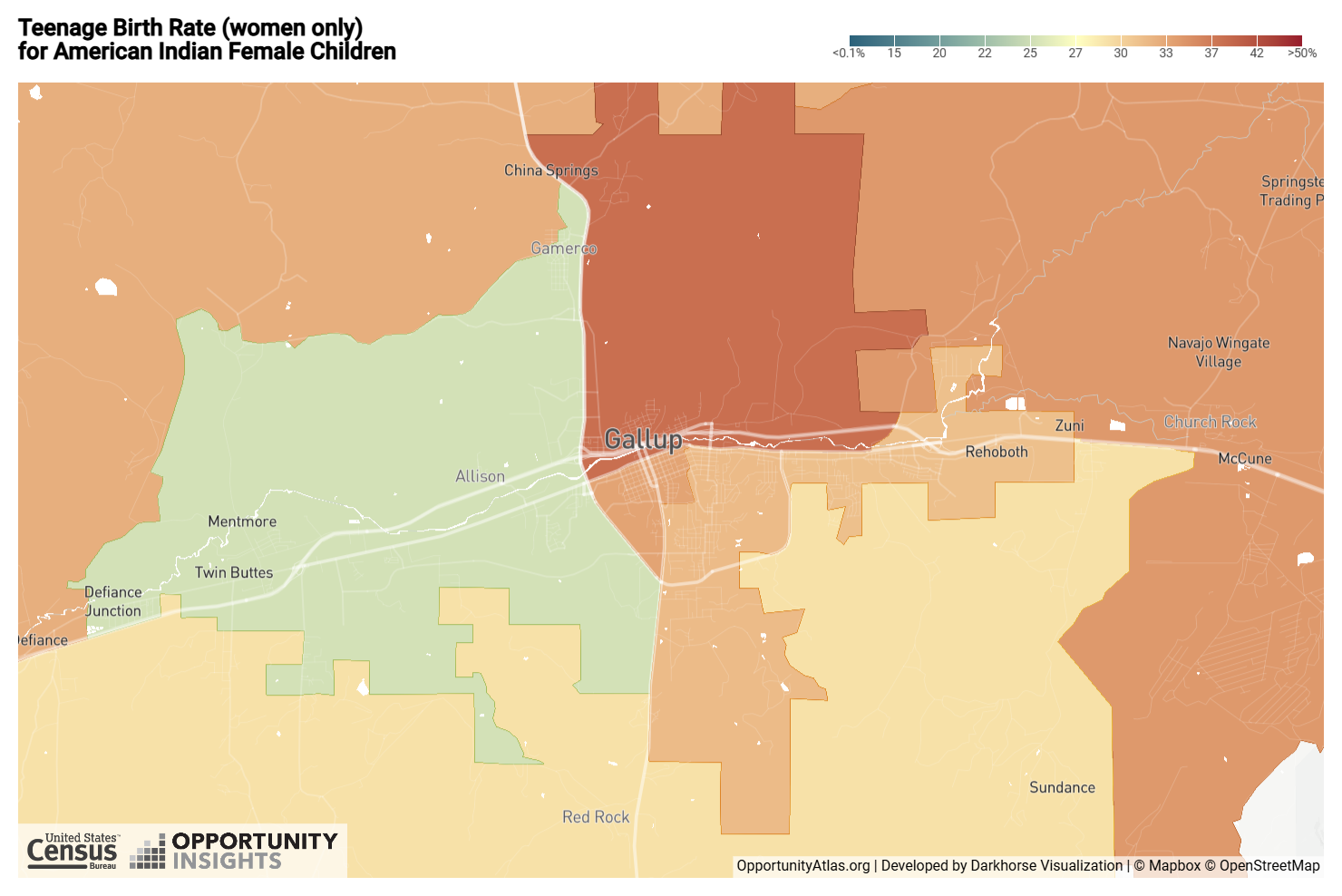
More than 42%. That's the statistical prediction for an American Indian girl growing up where I grew up. Not a moral judgment. A number. The map doesn't know me. It knows the system.

Look at that map. The entire region is the same flat tan. There is almost no variation, not because the data is missing, but because the outcome is so consistent that differentiation is nearly meaningless. For Native girls from middle income families in this part of New Mexico, the college graduation rate hovers somewhere between 5 and 8 percent.
I graduated from Dartmouth.
I work for the United Nations in Vienna.
I negotiate with donors, brief the Executive Director of my organization, and navigate international development finance initiatives across time zones and languages.
The distance between that map and this résumé is not a story about hard work. It is a story about what hard work can and cannot do on its own—and about the specific, improbable combination of luck, stubbornness, and people who showed up at exactly the right moment that got me from there to here.
Despite the odds, the predictions, the assumptions about a "girl like me," I never lost hope. I kept striving. I refused to give up.
And I also got very, very lucky.
The 80/20 problem (and really, if we are bing honest, it is more like the 98/2 problem)
A recent op-ed in The Dartmouth described Dartmouth's current admissions direction with a phrase that has been rattling around in my head ever since: Beilock "seemingly wants a school that is 80% wealthy and 20% unicorns—first generation college students from working class backgrounds and Pell Grant recipients."
I am a Pell Grant recipient.
I am a first generation college student.
I am a unicorn.
I do not mean that as a compliment to myself. I mean it precisely the way the author intended: I am a statistical anomaly. I am the exception that the system produces rarely enough to be remarkable, and just frequently enough to be useful. Useful to institutions that need proof of concept. Useful to admissions offices that need a photograph for the brochure. Useful to the 80% who need evidence that the system works: Because if it produced me, it must be fair, right?
Here is what I want the 80% to understand: my existence is not evidence that the system is fair. My existence is evidence that occasionally, against significant odds, someone escapes a system that was not designed for her.
Those are not the same thing.
What luck looks like from the inside
I did not get to Dartmouth because I was the most deserving girl in Gallup. I got there because I was stubborn, because I had teachers who saw something in me, because my family made sacrifices I am still not fully able to articulate, and because at several critical moments, the door (or a window) happened to be open at exactly the moment I needed it.
I know girls from my hometown who were smarter than me. More disciplined. More resilient. Made better choices than me. Who had every quality I had, and more—and who are still in the map's prediction. Not because they failed. Because the door was not open when they arrived at it.
That is what survivor's guilt actually is. It is not guilt about succeeding. It is the recognition that the difference between my life and theirs is not entirely, or even primarily, a function of merit. It is a function of timing, and luck, and a system that produces unicorns instead of equitable outcomes.
A system that consistently produces unicorns is not a fair system. It is a system with excellent PR.
What I want from the 80%
I am not asking the 80% to feel guilty about where they started. Guilt is not useful here. I am asking for something harder than guilt: I am asking for an honest reckoning with what "normal" actually means.
If you grew up in a household with two college-educated parents, in a neighborhood where the schools were funded, where no one in your family had ever been subject to a treaty violation or a federal boarding school or a termination policy—your starting line was not neutral. It was the result of a system that was actively designed, over generations, to produce you and not to produce me.
Knowing that does not make you a bad person. It makes you someone who has accurate information about how the world works. What you do with that information is the question.
Dartmouth was founded in 1769 with a charter obligation to educate Native Americans. I am a descendant of the people that charter was written to serve. I have spent twenty years showing up for this institution—as a student, as a volunteer, as a donor—because I believe that institutions can, and should, be held to their stated values. But only if enough people refuse to let them off the hook.
That belief is harder to sustain when the institution's response to a peaceful protest by its most vulnerable students is to send officers in riot gear.
It is harder to sustain when the same people who were reluctant to sign a letter about those students activated quickly and completely when the victims were named women with documented settlements.
It is harder to sustain when Leon Black's name is still on a building despite the mounting evidence of who he truly is and all the evidence of the pain he has wrought, not to mention the myriad laws he may have broken.
It is harder to sustain when the admissions policy seems designed to produce just enough unicorns to make the 80% feel like the system is working.
I sustain it anyway. Because the alternative is to cede the institution to the people who are comfortable with it exactly as it is.
What I want the girl in Gallup to know
The map is not your destiny.
I know that is easy for me to say from Vienna. I know it can sound like exactly the kind of thing someone says when they got out, when the luck broke their way, when the door happened to be open. I know how hollow "you can do it" sounds when the data says something different.
So let me say the other thing, the thing I wish someone had said to me: the odds against you are real. The system is real. The things that make it harder for you than for the girl across the state (or across the country) are not in your head. You are not failing to try hard enough. You are navigating a set of obstacles that were not placed there by accident.
And you deserve better than a system that produces unicorns.
You deserve a system that was actually built for you. One that was built with your success as not just a possibility, but a probability.
The difference between those two things is worth fighting for. Even from Vienna. Even when it costs something.
Especially when it costs something.
Christine Benally Peranteau is an enrolled member of the Navajo Nation, a member of the Dartmouth Class of 2006, and a former Co-Chair of Women of Dartmouth. She works in international resource mobilization and lives in Vienna, Austria. She writes at benallyperanteau.com.
The views expressed in this post are her own and do not represent the positions of the United Nations, the United Nations Office on Drugs and Crime, Women of Dartmouth, or any other organization with which she is affiliated.
Data and maps: Opportunity Atlas, developed by Opportunity Insights at Harvard University in partnership with the U.S. Census Bureau.